On 21 October 2026, ChainSecurity published a vulnerability in Vultisig, an open-source, self-custodial MPC wallet that according to ChainSecurity protects more than $500M across dozens of chains. An attacker who controlled one of the devices participating in a wallet could, by repeatedly causing signing attempts to fail, recover the secret state of another device and from it the full private key. To the user, the failed attempts appeared as a generic error. Vultisig merged changes addressing the issue in August, two months before the publication.
In Beyond TEE and MPC we looked at where custody policies are enforced and argued that enforcement on a vendor’s infrastructure puts the vendor in the trust path. The Vultisig incident concerns a different dependency of off-chain custody: the disclosed attack did not exploit a flaw in the MPC protocol or in the audited library that implements it, but the application’s failure to do what the library required of it.
What happened
In normal operation, threshold ECDSA lets a quorum of participants produce a signature from separate key shares without ever reconstructing the private key. Under the protocol’s security assumptions, an attacker who controls fewer participants than the threshold can neither produce a signature on their own nor recover the secret shares of the honest participants.
In the scheme Vultisig uses, the initial setup gives each device, in addition to its key share, a secret seed that is reused across later signing sessions to make them faster. This is internal protocol state, unrelated to a wallet’s recovery phrase. ChainSecurity points out that it is as sensitive as the key share, since a party that learns another device’s seed can compute that device’s share.
The attack exploits how the honest device reacts to manipulated input. A malicious participant can craft its protocol messages so that whether the honest device detects the manipulation and aborts depends on the value of a single bit of the honest device’s seed, so observing whether a signing attempt fails reveals that bit. Repeating this over many attempts recovers the seed bit by bit and then the honest device’s key share. Combined with enough other shares to meet the threshold, for example the attacker’s own share in a two-device vault, this yields the full private key.
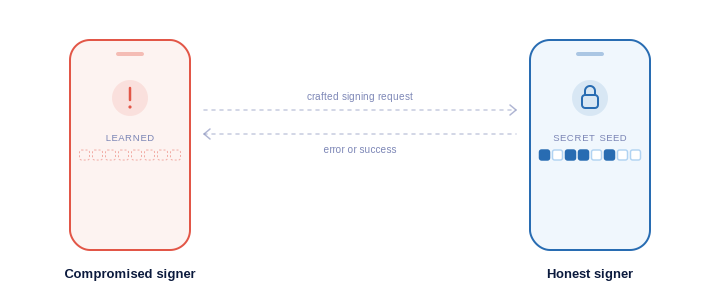
The attacker needs control of one participating device, and the honest device has to keep taking part in signing sessions with it. The disclosure does not state how many attempts a full extraction requires.
The application did not enforce the library’s abort requirement
Vultisig uses Silence Laboratories’ implementation of the DKLs23 protocol, whose repository lists a 2024 security audit by Trail of Bits. The library detected the manipulated messages and returned an error that ChainSecurity quotes as “abort protocol and ban party”. That error carries an obligation: because the attack depends on the honest device continuing to run the protocol with the same secret state, the device must stop signing with that counterparty until the seed is replaced. The library left enforcing this to the calling application.
Vultisig’s app did not enforce it. According to the description of the fix, the Android app retried up to three times against the already-banned peer and then showed a generic failure message, which gave the user no reason to stop using the compromised device. The changes merged in August for Android and iOS recognise the library’s malicious-party errors, skip the retries and warn the user against further use of the flagged device. ChainSecurity states that it has not reviewed these changes, and press coverage notes that the published changes do not show whether the protection holds across restarted sessions.
An audit of a library does not establish that an application using it meets the library’s security assumptions, and in this case the application did not.
Security is only as strong as its weakest link
Threshold signing protocols come with security proofs, but each proof holds only under conditions that the implementation must meet: every proof the protocol requires is computed and checked, aborts are handled as specified, and secret state is not reused after a failure. Each condition is an obligation on some layer of the software, and failures have occurred at each layer.
In 2023, Fireblocks researchers disclosed BitForge, a set of vulnerabilities in implementations of the GG18, GG20 and Lindell17 protocols that affected more than 15 wallet providers and open-source projects. In GG18 and GG20, the published protocols did not require a proof that a participant’s Paillier modulus is well-formed, and in some implementations a malicious participant could extract the full key after 16 signatures. In Lindell17 implementations, the handling of failed signing attempts deviated from the paper, and the key could be recovered after roughly 200 attempts. Together with the Vultisig case, these are failures at three different layers: in the protocol specification, between the specification and the implementation, and between the library and the application.
An MPC wallet is therefore secure only if the protocol, its implementation, the application orchestrating it, the network and session handling, and the devices are all correct at the same time, and a failure in any of them can expose the full key. An audit usually covers one of these layers. ChainSecurity draws the same conclusion: as a few cryptographic libraries become standard and receive intense scrutiny, “the orchestration layer around them will then be the weak link.” Onchain systems consist of many components too, so the useful comparison is which components can cause a total loss when they fail, and whether anyone other than the vendor can inspect them.
Public source enabled independent review
Vultisig publishes its source code, which allowed independent researchers to analyse it, report what they found and publish their findings once changes were in place.
Closed-source MPC products implement the same protocol families and need the same kind of orchestration around them, so the obligations described above apply to them as well. We think it is likely that some of them contain similar integration failures, but this is an inference from the cases above, not a finding: we have no evidence of a specific vulnerability in any closed-source product. What differs is who can look. Closed code is reviewed by the vendor and by auditors the vendor selects, the resulting reports and their scope are often not published, and a customer therefore has fewer ways to assess how a product handles these failure modes.
Closed source is not secret source
Restricting access to source code makes inspection harder for outsiders, but the confidentiality of source code can fail. Proprietary code exists in many copies, on developers’ machines, in build systems and on hosted repositories, and an attacker needs only one of them. Thefts of source code from security-critical companies are well documented:
- In 2022, Okta’s code repositories were copied. In the same year, attackers took source code and technical information from LastPass and used that information in a follow-up attack, in which they obtained credentials that gave them access to the cloud storage holding encrypted customer vault backups.
- In March 2024, Microsoft disclosed that the Russian state actor Midnight Blizzard had gained access to some of the company’s source code repositories and internal systems.
- In May 2026, attackers claimed to have exfiltrated about 3,800 of GitHub’s internal repositories after an employee installed a malicious editor extension, a figure GitHub described as consistent with its investigation.
Attackers who target crypto go after the people who build and operate this software in particular. North Korea’s “Contagious Interview” campaign approaches developers with fake job offers and infects their machines through coding tests, and a joint advisory by seven agencies links it to funds or credentials taken from more than 7,000 wallets. In 2024, the same approach reached a wallet software vendor: according to the FBI, a fake recruiter’s coding test infected an employee of the Japanese company Ginco, and the attackers likely used that access to manipulate a transaction of its customer DMM Bitcoin, taking about $308M in BTC. While we were writing this post, news of a hack at Binance came in: on 29 October 2026, attackers took about $6.3B from Binance, the largest crypto theft on record, which the FBI has attributed to North Korea. According to Binance’s initial investigation update, the incident may have started with a compromised laptop and turned out to involve additional points of breach. The facts of that incident are still being established, but both cases show that the machines and internal systems of the people who build and operate custody infrastructure are a practical target.
AI makes access to source code more valuable. In April 2026, Anthropic reported that its Claude Mythos Preview model found and exploited previously unknown vulnerabilities in every major operating system and web browser, among them a remote code execution flaw that had been present in FreeBSD for 17 years. These results suggest that AI can reduce the effort required for some kinds of vulnerability research. They do not establish how easily it finds integration flaws in MPC systems, and vendors and their auditors can use the same tools. The asymmetry lies elsewhere: for open-source code, attackers and every independent researcher can apply these tools, while for closed-source code only the vendor, its auditors and any attacker who has obtained a copy can, and the vendor’s customers cannot know whether a copy has leaked.
Moving enforcement onchain
If every component that can cause a total loss is a point of attack, the remedy is to reduce the number of such components and to make the remaining ones inspectable. Zodiac does this by moving the rules that decide whether funds can move into smart contracts, which the chain enforces as part of executing each transaction. A role in Zodiac specifies which contracts its members may call, which functions, which parameter values are allowed, and how much may be spent per period. A transaction submitted through a role reverts if it fails these checks, regardless of which interface built it.
Role members do not run a joint protocol. Each member authorises a transaction with its own key, and the contract verifies the signature, so a compromised member cannot learn anything about another member’s key, and the class of attack described above does not arise. An attacker who compromises a member obtains that role’s permissions and nothing beyond them. The permissions limit which calls are possible, not whether a permitted call is economically safe: broad token approvals, upgradeable target contracts or loose parameter conditions can still expose substantial value, and a per-period allowance can be spent again in every period until the member is removed.
The deployed contracts and each account’s configuration are public onchain state, so anyone can inspect them independently. A review of a deployment still has to establish which implementation runs, whether that version was audited, how it is configured, and which authorities can change the configuration or bypass it, but every one of these questions can be answered from the chain without the vendor’s cooperation. With an application, even an open-source one, a user cannot easily verify that the build running on their device corresponds to the reviewed source.
The authority that can change the policy is the most sensitive part of such a setup. We recommend routing policy changes through a delay in Zodiac, which queues a transaction onchain for a fixed period during which it can be cancelled. This only helps if there is no other way to change the policy that skips the delay, and if someone watches the queue and can cancel a malicious change in time.
Onchain enforcement does not replace strong key protection, and for the most critical setups you may even combine them, with each role member being an MPC wallet or a key held in a hardware security module. The two layers address different failures. MPC or an HSM makes the key harder to steal, and the policy limits what a stolen key can do, so an MPC key extracted as in the Vultisig attack would yield only the permissions of its role. Neither layer protects against a flaw in the other: a bug in the policy contracts can bypass the signers entirely.
Securing the last line of defence
If the policy contracts are what stands between a compromised key and the funds, they are the last line of defence, and a bug in them is where the most critical losses can occur. Smart contracts do have bugs, and ours are no exception. They are, however, not where most losses come from. In our taxonomy of the April 2026 exploits, the largest cluster of losses came from compromised or overbroad authority, such as stolen admin keys, keepers with more permissions than they needed and signers tricked into approving arbitrary calls, which are exactly the failures an onchain policy is meant to contain.
We are optimistic that the contract layer can be made very robust, because securing it is a tractable problem. Deployed contract code is immutable and public, so it is a fixed target: once reviewed and verified, it stays as it was reviewed, and every audit, finding and proven property adds to what is known about the same code. Independent researchers, auditors and the teams that build on these contracts can all work on it together, using the same AI-assisted tools that make attackers more capable. A closed-source vendor system is a moving target by comparison: it changes with every release, any release can introduce a new bug, and only the vendor and its chosen auditors can look for it.
Zodiac contracts have processed more than $15B in transactions since 2023 and have been reviewed in multiple independent audits. We are now pushing to extend formal verification to all of their security-critical properties, so that the guarantees the contracts are meant to provide are proven rather than only tested.
Choosing custody
When evaluating a custody setup, three questions are worth asking:
- Which components, if compromised or faulty, can lead to the loss of all funds?
- Can I, or an auditor I choose, inspect those components?
- Can I verify that the code I inspected is the code that runs?
For closed-source off-chain custody, the answer to the second and third questions is usually that you have to rely on the vendor and its auditors. With onchain enforcement, both can be answered from the contracts and the account’s state on the chain. MPC and hardware security modules remain good ways to protect the keys themselves, and combined with an onchain policy, the compromise of a key is limited to what its role permits.
Our comparison of smart custody and MPC covers the differences in more detail. If you want to go through your own setup, book a call with us.